healthcare culture coaching · psychological safety in healthcare · them and us NHS culture
Beyond “Them and Us”: Coaching as a Bridge in Healthcare Culture
The "them and us" divide in healthcare is a stress response, not a character flaw. Under sustained pressure, staff narrow focus to protect expertise and emotional energy, while patients escalate concerns about communication more than clinical decisions. Coaching-based leadership, psychological safety, and models like Experience-Based Co-Design and Schwartz Rounds all shift teams from defensiveness to dialogue, improving both staff wellbeing and patient outcomes.
22 July 2026 · Axis Culture Group · 7 min read
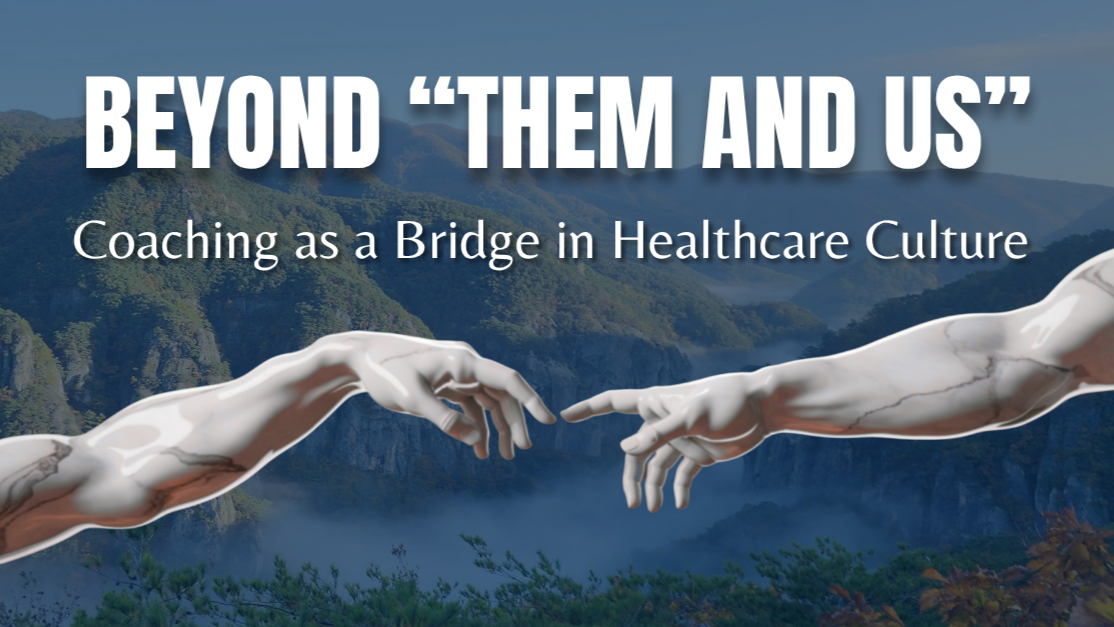
Beyond "them and us": coaching as a bridge in healthcare culture.
In the Emergency Department, no one looked careless. Patients wanted acknowledgement. Staff wanted understanding. The divide wasn't rooted in bad intent, it was rooted in unprocessed pressure.
I remember sitting in an Emergency Department, not as a leader, but as a relative. The room was tense. Patients were tired, worried, and frustrated. Staff were moving quickly, clinically focused, carrying visible pressure. No one appeared careless. And yet the atmosphere felt divided.
On one side, patients and families asking: "Why is no one explaining what's happening?" On the other, healthcare staff thinking: "We are doing everything we can." The clinical work was being done. The relational work was strained.
This isn't new. I've heard it before: the doctors and nurses "them and us", the leaders and the team "them and us", the nurses and support workers "them and us". I am patient, relative, nurse, leader, educator, coach. Am I them, or us?
That subtle fracture, the emergence of "them and us", is one of the most underestimated risks in healthcare systems today.
Why the divide emerges under pressure
Healthcare, particularly urgent and emergency care, operates in sustained high-alert mode. Neuroscience and organisational psychology tell us that under threat, human beings narrow their focus. We protect our identity, our expertise, and our emotional energy.
In healthcare, this often manifests as role-based defensiveness. Clinicians protect clinical judgement. Managers protect operational flow. Educators protect standards. Patients protect their dignity and safety.
Burnout research makes this dynamic even clearer. Emotional exhaustion and depersonalisation, the distancing of oneself from those receiving care, are not a moral failing. They are a psychological coping response. When clinicians are overwhelmed, empathy becomes harder to sustain. At the same time, large-scale complaint analyses consistently show that patients are more likely to escalate concerns about communication than about clinical decision-making. Feeling unheard or poorly informed is more predictive of dissatisfaction than adverse outcomes themselves.
Clinical competence is essential. Relational competence determines how that competence is experienced.
Psychological safety: the precondition for compassion
If compassion is to be sustained, psychological safety must exist. Teams where individuals feel safe to speak up, admit uncertainty, and reflect openly perform better and report fewer serious failures. In healthcare, this has direct implications for patient safety.
NHS workforce research has repeatedly shown correlations between higher staff engagement and improved patient satisfaction, lower mortality rates, and stronger regulatory ratings. Compassion towards patients is not independent of staff experience. It flows from it.
When teams operate in fear, scrutiny, or chronic overload, defensiveness increases. Defensive systems create distance. Distance creates the many layers of "them and us".
Coaching as cultural infrastructure
Coaching addresses this not by adding another initiative, but by shifting how leaders engage with complexity. Coaching-based leadership replaces reflexive judgement with structured curiosity. Instead of defaulting to performance interrogation, leaders create reflective space. Questions such as "What was happening for you?" help staff move from a defensive to a learning posture.
This shift matters because learning cultures reduce blame and increase accountability simultaneously. Coaching does not remove standards. It strengthens the conditions under which standards can be upheld.
Four bodies of research, one shared direction.
Psychological safety
Teams that feel safe to speak up and admit uncertainty perform better and report fewer serious failures.
Burnout & depersonalisation
Emotional exhaustion drives distancing from patients, a coping response, not a moral failing.
Experience-based co-design
Bringing patients and staff together around lived experience improves outcomes and softens polarity.
Schwartz Rounds
Structured reflective practice reduces psychological distress and increases empathy and teamwork.
Experience-based co-design: evidence in action
One of the most compelling models bridging "them and us" is Experience-Based Co-Design (EBCD). Developed in the UK and now implemented internationally, EBCD brings patients and staff together to identify emotional "touchpoints" in care journeys and collaboratively redesign services.
Rather than beginning with performance metrics, EBCD begins with lived experience. Patients share moments that felt confusing, frightening, or affirming. Staff share their own experiences of delivering care under pressure. These narratives are then analysed together to identify shared priorities for improvement.
Evaluations of EBCD have demonstrated improvements in patient experience scores, staff morale, and the sustainability of service redesign. When patients and staff watch filmed narratives of each other's experiences, empathy increases and the polarity softens. The model reframes the system from opposing positions to shared stewardship.
Reflective practice and relational resilience
Structured reflective interventions such as Schwartz Rounds provide further evidence that relational work strengthens systems. Staff who participate report reduced psychological distress, increased empathy, and improved teamwork. These forums legitimise the emotional dimension of healthcare, which often goes unacknowledged in operational discussions.
When leaders model reflective dialogue consistently, not only in scheduled rounds but in everyday meetings, relational resilience grows. Teams begin to speak more openly about pressure rather than internalising it. Emotional load becomes shared rather than suppressed.
Bridging educators and practitioners
The divide between educators and practitioners often mirrors the patient-staff polarity. Educators advocate adherence to evidence-based standards. Practitioners navigate real-time constraints that make perfect compliance difficult. Without dialogue, this tension becomes adversarial. With coaching-informed leadership, it becomes generative. Co-design does not dilute standards. It embeds them more deeply.
Governance, risk and relational quality
For executive leaders and boards, the relational dimension is not peripheral. It is central to risk management. Relational fracture contributes to complaint escalation, grievance processes, staff attrition, and reputational harm. Conversely, systems characterised by psychological safety, reflective practice, and co-design demonstrate stronger engagement metrics and more stable cultures.
The question is not whether healthcare systems are under pressure. They are. The question is whether that pressure produces defensiveness or dialogue.
From "them and us" to "all of us"
Sitting in that Emergency Department, what struck me was not incompetence. It was disconnection. Patients wanted acknowledgement. Staff wanted understanding. Both wanted reassurance. Healthcare is not only a technical enterprise. It is a human one.
- Curiosity over blame, so staff move from defensive to learning.
- Shared learning over hierarchy, so standards are upheld through ownership, not compliance.
- Co-design over imposition, so patients and staff redesign care together.
We cannot eliminate pressure from healthcare. But we can change how systems metabolise it.
When leaders choose curiosity over blame, shared learning over hierarchy, and co-design over imposition, the language of "them and us" begins to fade. And what replaces it is something quieter but far more powerful.
Want to work with us on this?
Book a consultation