
middle managers NHS · health and social care leadership · middle management development · integrated care
Caught in the Middle: The Quiet, Relentless Work of Middle Managers Across Health and Social Care
Middle managers do not just sit between layers of hierarchy, they sit between worlds. Across the NHS and social care they absorb pressure from above and distress from below, hold culture together without the authority to fix what undermines it, and feel the fracture first when the two systems fail to talk to each other. Supporting the middle is not a nice to have, it is how integrated care succeeds.
4 September 2026 · Axis Culture Group · 9 min read
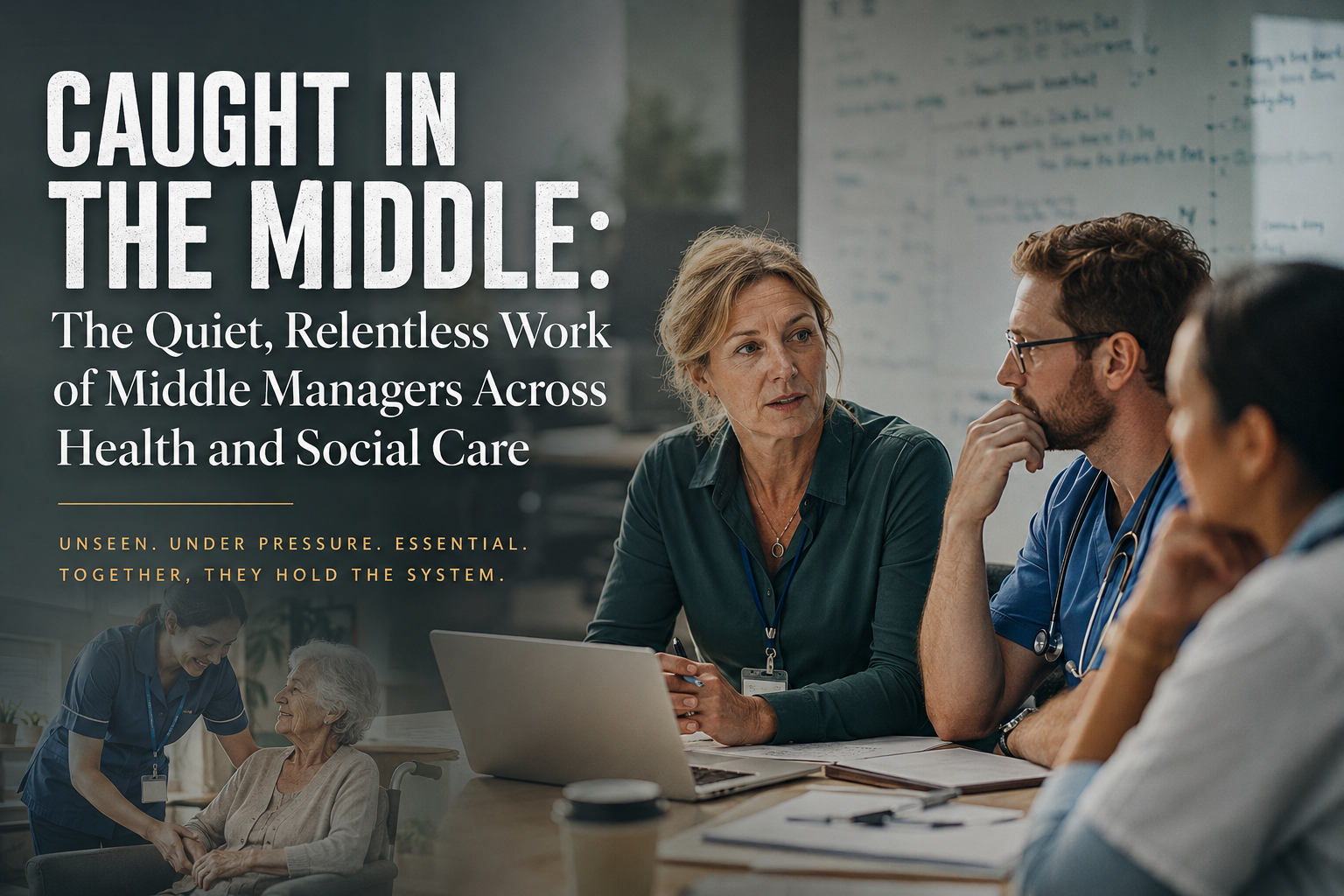
Caught in the middle: the quiet, relentless work of middle managers across health and social care.
They sit between the hopes of senior leaders and the exhaustion of frontline teams, between policy and reality, between what should happen and what can happen. And they carry it all.
If you sit with middle managers long enough, in a hospital office after a long shift, in a care home corridor during a rare quiet moment, or in a community service meeting room where the kettle never quite boils fast enough, you start to hear the same truth spoken in different ways.
It is the truth that rarely makes it into strategy documents or ministerial speeches. It is quieter than that, it is more human.
"I am in the middle of everything, and sometimes it feels like I am holding the whole thing together."
Middle managers do not just sit between layers of hierarchy. They sit between worlds, and they feel this acutely. They sit between the hopes and directives of senior leaders and the exhaustion of frontline teams. They are not in one select ward or system. They are in management and leadership roles across the NHS and social care. They sit where the two systems that depend on each other align and yet often behave as if they are total strangers. They do not see the similarities, the synergies, between policy and reality, and between experience and requirement. They are the pivotal point between what should happen and what can happen, and they carry it all.
The recent King's Fund long read on why management matters for the NHS long term plan puts words to something many managers have felt for years. It discusses how the system leans heavily on them, yet invests inconsistently in their development, wellbeing, and professional identity. When you add social care into the picture, the strain becomes even more pronounced. Social care managers are carrying just as much, often with fewer resources, less recognition, and more fragmented structures. To the public, social care is less visible, less discussed, and for a role that is often undervalued in the more visible NHS, the middle manager in social care can be almost invisible. Until we need them both, we do not see them. They are stuck in the middle, but not alone.
Yet behind the evidence, behind the policy analysis, behind the organisational charts, there are real people living this every day.
What it really feels like to be in the middle
Middle managers often describe their role as being in the middle, but that phrase does not capture its emotional reality. Being in the middle means being the person a team member or nurse comes to when they are overwhelmed after a traumatic shift, and being the person a senior leader comes to when they need reassurance that the new initiative will be delivered by Friday.
It means holding the distress of a care worker who has just supported someone through end of life care, while also holding the pressure of a commissioner who needs data for tomorrow's meeting.
It means explaining new digital systems to frontline staff, then explaining frontline realities to digital teams who have never worked a busy night shift.
It means absorbing frustration from teams who feel unheard, while absorbing pressure from leaders who feel accountable to regulators, politicians, and the public.
It means being the one who stays late to fix a rota crisis, then arrives early the next morning to support a colleague who had a difficult night.
It means carrying responsibility for culture, psychological safety, compassion, and inclusion, without always having the authority to fix the structural issues that undermine them.
Across both health and social care, middle managers describe a particular kind of loneliness. Not because they lack people around them, but because their challenges do not neatly fit into the categories of frontline or executive. They are neither, yet they are both. They are the connective tissue of the system, and connective tissue is rarely noticed until it is strained, stretched and a pain point.
Two systems, one shared pressure
The King's Fund report focuses on the NHS, but its insights echo loudly across social care. Both sectors rely on middle managers to hold teams together, interpret policy, manage crises, support wellbeing, deliver improvement, and navigate digital transformation. Both sectors expect them to be emotionally intelligent, operationally sharp, politically aware, and endlessly adaptable to rapid change. Yet both sectors often overlook the emotional labour and professional skill required to do this well.
Social care managers, in care homes, community care, domiciliary and live in care provisions in particular, frequently operate with profound staffing issues, tighter budgets, fewer layers of support, and more fragmented organisational structures. They carry the emotional intensity of supporting people's daily lives, not just their health episodes, and they do it in a sector that is often misunderstood or undervalued by those in the acute sector, the public and commissioners.
And when health and social care fail to work together, middle managers feel the fracture first. They are the ones trying to coordinate discharges, negotiate care packages, manage expectations, and bridge communication gaps, often without shared systems, language, or priorities. The strain of this fragmentation lands directly on their shoulders.
Four pressures that land on one pair of shoulders.
Emotional labour
Holding the distress of teams and the expectations of leaders, often on the same day, with nowhere to put either.
Responsibility without authority
Accountable for culture, safety and inclusion, but rarely able to change the structures that undermine them.
System fragmentation
Discharges, care packages and communication gaps are absorbed by the people bridging health and social care.
Professional invisibility
Management is still treated as a task rather than a profession, so development and recognition arrive inconsistently.
Every senior leader has walked through this fire
Speak to senior leaders who have risen through health or social care, and many will quietly admit that their hardest years were spent in middle management. Those were the years when they learned how complex leadership really is. When they discovered how lonely it can feel. When they realised that the system runs not on policy, but on relationships, and that middle managers are the ones who hold those relationships together.
They remember the late night phone calls, the impossible decisions, the emotional weight of supporting staff through crises, and the pressure of delivering change without the authority to shape the system. These stories matter because they reveal something the system often forgets.
Middle managers are not just operational cogs. They are human beings navigating emotional, cultural, and political complexity every single day.
The future depends on supporting the middle, together
The King's Fund report is clear. The ambitions of the NHS ten year plan cannot be delivered without investing in management. This has to be addressed more widely than the acute sector for all the reasons we have named. The same is true for social care, and the truth is even bigger than that: we cannot support middle managers unless we support the relationship between health and social care.
Middle managers need protected time, reflective space, coaching, professional recognition, digital capability, emotionally intelligent leadership development, and cultures that value and recognise management as a profession, as a career choice. However, they also need systems that talk to each other, not past or around each other. They need shared priorities, shared language, shared expectations.
We have seen a move to shared commissioning through the ICBs, but is this a reality or more smoke and mirrors? How does this feel, as two middle managers both supporting the patient pathway and journey, not as joined up as it should be and could be, with joint approaches to support and education? Integrated care will not succeed because of structures. It will succeed because middle managers are supported to lead across boundaries.
How Axis Culture Group strengthens the people who hold the system together
This is exactly where Axis Culture Group places its focus. We work with middle managers across health and social care who feel stretched, stuck, or unseen, and help them rediscover clarity, confidence, and presence. Our programmes are shaped by lived experience, grounded in evidence, and designed by those in and for the real world.
- Reflective space, where managers can breathe, think, and reconnect with their purpose and each other.
- Identity level leadership, not just skill based competence.
- Support for the emotional reality of being in the middle, and preparation for the digital future of integrated care.
- Cultures that see the middle, so managers are valued, respected, and recognise that they were never alone.
Middle managers deserve more than being told they need resilience. They deserve investment, care, and professional recognition, not just across both systems but from all of us.
We work with those in the middle to feel seen and heard every day. Axis Culture Group exists to make that investment real, practical, and transformational.
Want to work with us on this?
Book a consultation