
upward influence · middle managers · compassionate rigour · healthcare leadership · speaking up
Speaking Upwards: The Leadership Conversation We Do Not Talk About Enough
Influence, compassionate rigour and learning how to say no when the person above you holds the authority.
24 September 2026 · Dr Nichola Ashby · 13 min read
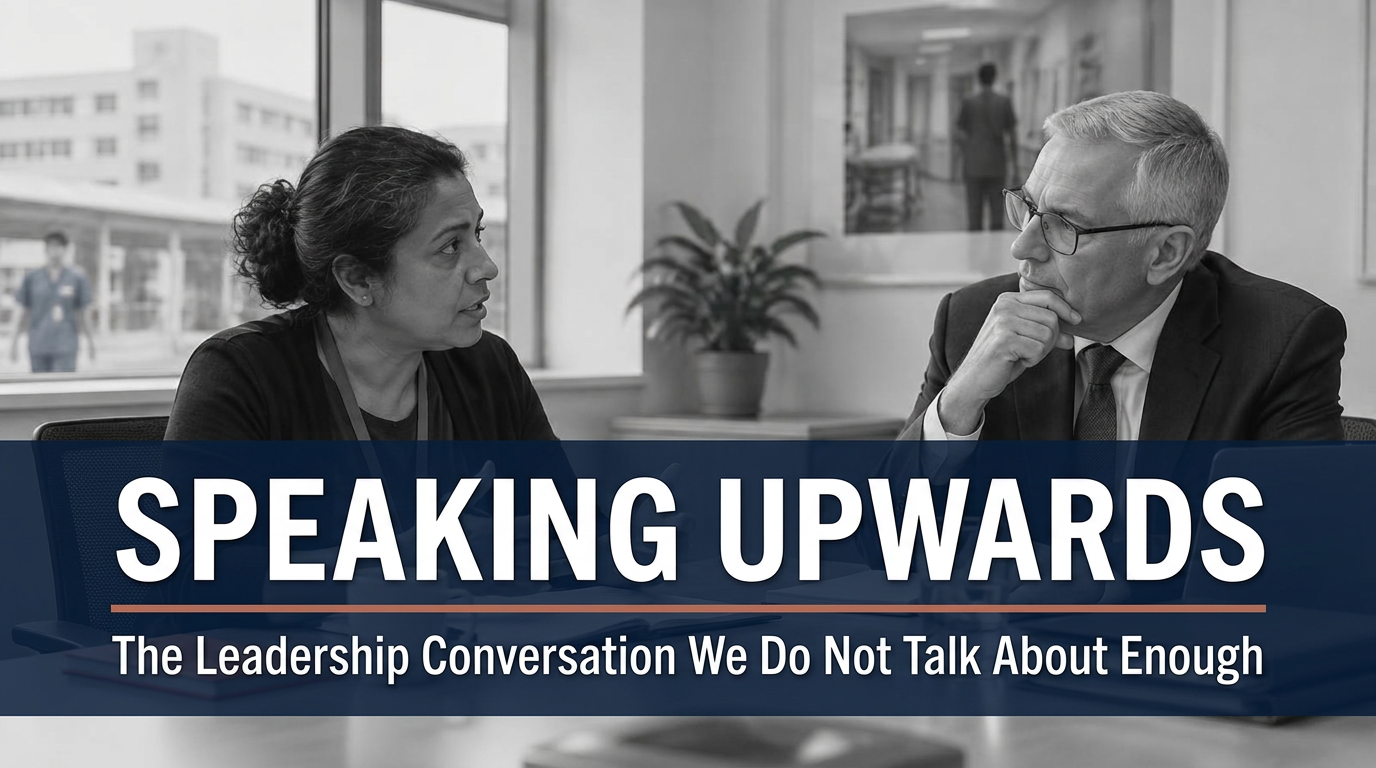
Influence, compassionate rigour and learning how to say no when the person above you holds the authority.
We spend a great deal of time teaching managers how to have conversations with the people they lead, whether that is about performance, behaviour, development, absence, change or something that has gone wrong. What I think we spend considerably less time talking about is the conversation that has to go the other way.
How do you challenge upwards? This is a question I have asked myself throughout my career and often done this poorly or not at all. This has been due to a lack of confidence or knowledge, or even doubting my own emotional intelligence.
How do you tell somebody more senior that something is not working, that the timescale is unrealistic, that the service cannot safely absorb another priority, or simply that you disagree with what is being proposed? More importantly, how do you do this without becoming so cautious that the message disappears, or so frustrated that the conversation damages the very relationship you need to have influence?
For middle managers, this is not an abstract leadership question. It can be part of the job almost every day. They occupy that difficult space between organisational ambition and operational reality. They hear the expectations coming down through an organisation, but they also see what happens when those expectations meet staffing levels, patient demand, competing priorities and the capacity of real teams. At times their role is to make things happen. At other times, their responsibility is to say that something cannot happen as currently proposed.
I've found that second part can be much harder.
This is particularly important in healthcare, where hierarchy and professional boundaries can shape whether people feel able to speak and how quickly they do so. Research in English intensive care units has shown that challenging professional boundaries and hierarchies can be difficult, while more recent reviews of nursing voice similarly identify hierarchy, relationships, trust, and psychological safety as key influences on whether staff speak up or remain silent. (PubMed Central (PMC)) NHS England's Freedom to Speak Up guidance therefore places responsibility not only on individuals to raise concerns, but on leaders and managers to create cultures in which speaking up is encouraged and used for learning and improvement. (NHS England)
Yet not every upward conversation is a formal Freedom to Speak Up issue. Many are much more ordinary than that, and perhaps because they are ordinary, we do not prepare people for them nearly enough.
Consider a manager like Daniel
Daniel is a composite of situations many of us will recognise.
He is an experienced operational manager working across a busy healthcare service. His director has asked the service to introduce a new pathway within eight weeks. Daniel understands why the organisation wants it. The change has strong strategic reasons. The executive team is under pressure to show progress, and nobody suggests the pathway itself is a bad idea.
The difficulty is timing. Two vacancies remain unfilled, sickness is high in one team, and another major change programme is already under way. Daniel's clinical leads are telling him privately that they can probably launch something in eight weeks, but they do not believe they can do it well.
Daniel agrees. Then comes the difficult part. He must tell his director. His first instinct is to gather more information. He revises the workforce figures, checks the implementation plan again and asks colleagues what they think. By the time the meeting comes around, he has a detailed understanding of the problem, but he still has not decided how to say what actually needs saying. Many managers will recognise this moment. The barrier is often not knowing what the issue is. The barrier is working out how to carry the message upwards.
This is where I think three relatively simple leadership ideas can help: understanding the difference between authority and influence, using what we at Axis describe as compassionate rigour, and learning how to give a structured no.
In coaching, we discuss that authority and influence are not the same thing
Daniel's director has greater formal authority within the organisation. Pretending otherwise would be naïve. Titles, accountabilities and reporting structures matter, particularly in complex organisations such as the NHS. Yet, formal authority is only one source of power.
The classic work of French and Raven distinguished legitimate power associated with formal position from other sources of influence, including expertise and referent power; later developments also recognised the importance of information as a source of influence. (ResearchGate) That distinction remains useful because it reminds us that the organisational chart never tells us the whole story about who can influence a decision. Daniel may not hold the director's authority, but he holds things the director needs.
- He knows the service.
- He knows the teams.
- He understands the operational consequences.
- He has relationships with clinical colleagues and has delivered previous change successfully.
- He also has information from the frontline that is not necessarily visible at executive level.
All of these are potential sources of influence.
One pattern I often notice when working with middle managers is that they can focus heavily on authority they do not possess and, consequently, overlook the influence they do. The internal conversation becomes, “I can't say that because she is the director,” rather than, “What do I know, what relationships do I hold, and what responsibility do I have that makes this an important conversation for me to have?” That is a very different starting point.
Influence is also not manipulation. It is not about learning a clever technique to make a senior leader agree with you. It is about being sufficiently clear about what you know, what you are seeing and what matters that you can contribute meaningfully to the decision.
So, before Daniel goes into the meeting, I would ask him to identify his sources of influence. His service knowledge is one. His delivery track record is another. His relationships with the clinical teams are another, and the fact that those teams are aligned around the same implementation risk gives him something close to a coalition rather than an isolated opinion. Immediately, he is entering the room differently. He may not control the final decision, but neither is he powerless.
Then comes compassionate rigour
The second challenge is tone.
People sometimes hear “challenging upwards” and imagine a very robust, perhaps even confrontational, exchange. At the other end of the spectrum, managers who value relationships can soften the conversation so much that the actual concern is lost somewhere between “I completely understand” and “perhaps we could possibly think about...”. Neither is particularly helpful.
At Axis we use the term compassionate rigour to describe holding high support and high challenge at the same time. It is not a claim that compassion and challenge are opposites. In fact, I would argue that responsible leadership frequently requires both.
NHS England's guidance on compassionate conversations emphasises listening, suspending judgement, learning from others and navigating challenging conversations rather than avoiding them. (NHS England) The important point for leaders is that compassion does not mean the absence of standards, clarity or accountability.
For Daniel, compassionate rigour means he can recognise the pressure his director is under and still be unequivocal about what he believes the service can safely deliver. He does not need to make his director wrong to make his concern legitimate. That distinction can transform an upward conversation. Instead of opening with, “This timescale is impossible, and the team are really unhappy about it,” Daniel might say something closer to:
The message is still challenging, but it is not oppositional.
Daniel has acknowledged the organisational ambition, shown alignment with the purpose, and made the concern explicit. He has not hidden behind “the team says” or spent twenty minutes of background before getting to the point. This is compassionate rigour in practice: I respect you enough to understand your position, and I respect my own responsibility enough to tell you what you need to hear from me.
How do we learn to say no without closing the conversation?
Sometimes, however, influence and challenge are not enough, and a manager needs to say no, or at least “not like this”. That word can feel particularly difficult when it is directed upwards. For this reason, one of the simple tools we use is what I call the structured no. It has three movements:
- Acknowledge the request or context.
- State the position or principle you need to protect.
- Offer an alternative, choice or trade-off.
The value is that the “no” does not become the end of the conversation.
Daniel might therefore say:
That is not refusal for the sake of refusal. Nor is it the defensive “we don't have the staff” response senior leaders understandably find frustrating. It protects a principle, makes the constraint visible and puts choices back into the conversation.
Perhaps most importantly, it changes Daniel's role. He is no longer simply reporting a problem upwards and waiting for somebody more senior to solve it. He is exercising leadership by presenting the reality, the risk and the trade-offs. His director may still decide that the eight-week full implementation must proceed. Formal authority has not disappeared. But if that happens, the decision is now being made with a clearer understanding of what the organisation is choosing. That matters.
The conversation before the conversation
The part of upward influence we sometimes underestimate is preparation. A manager can know their subject extremely well and still enter a difficult conversation underprepared because they have prepared the evidence, but not the conversation itself. One of the most useful exercises I use is very simple. Pick one genuine upward conversation you have been postponing and identify what influence you carry into the room. It may be information nobody else has, a relationship, a record of successful delivery, support from other stakeholders, professional expertise, or an organisational principle you are responsible for protecting.
Then work on the opening, not the presentation or the seventeen points that follow. Work on the first two sentences. If you cannot say clearly why you are raising the issue within the opening moments of the conversation, there is a risk that anxiety will make you circle around it. Then rehearse the structured no or the ask aloud. This can feel artificial, particularly to experienced leaders, but rehearsal matters. The words that sound perfectly clear in a notebook can feel very different when spoken to someone who controls resources, reputation, or future opportunity. That power dynamic is real and should not be trivialised.
Research on healthcare voice reinforces this. Hierarchy can affect when people speak up, and studies consistently identify leadership behaviour, psychological safety, relationships and perceptions of potential consequences as important to voice. (PubMed Central (PMC)) Telling people simply to “be brave” therefore misses an important part of what is happening. For some people, upward challenge carries more perceived risk than it does for others. Culture, professional background, organisational experience, employment security and previous experiences of challenge may all shape how safe that conversation feels. We should acknowledge that rather than assuming everybody enters a senior leader's office from the same starting point.
This matters enormously when facilitating leadership development. I would never begin by asking the most confident person in the room to demonstrate what “good challenge” looks like and then imply everyone else simply needs to copy them. Give people quiet thinking time. Let them understand their own conversation first. Work in pairs before moving into a larger group. Allow them to experiment with the language and recognise that an effective upward conversation needs to sound like them, not like a script somebody has handed them.
We also need to stop these exercises becoming sessions where people vent about named senior leaders. Frustration may be real and sometimes entirely justified, but the development question is different: given the situation as it is, where is your influence and what are you going to do with it? That returns agency to the manager without pretending the organisational context does not matter.
Daniel in the meantime
Daniel enters the conversation knowing his director may disagree. That matters because successful upward influence isn't defined by getting the answer you want. He explains the implementation risks, acknowledges the strategic pressure and offers the two alternatives. His director initially pushes back, reminding him that the organisation has already publicly committed to the timetable. Previously, Daniel might have retreated at this point and said, “Okay, we'll do our best.” Instead, he stays with the conversation.
He asks whether the public commitment is to the full model or to commencement of the new pathway. That leads them to look again at what has been promised. They discover there is more flexibility than had assumed. The eventual decision is to begin a limited first phase on the original date and expand four weeks later, supported by a formal readiness review. Daniel did not win, and the director did not lose. They reached a different decision because the conversation brought together information from two levels of the organisation. Now that is upward influence at its best.
We need middle managers who can translate both ways
Organisations rightly expect middle managers to translate strategy downwards, helping teams understand what organisational decisions mean for their work. But another translation function is equally important. Middle managers must translate reality upwards. They are often the only people who can see the distance between a strategy as imagined and a strategy as experienced. If they do not feel capable of communicating that information upwards, senior leaders are left making decisions with an incomplete picture.
The answer cannot simply be to tell people to speak up more confidently. Senior leaders have a responsibility to create conditions in which challenge can be heard. NHS England's Freedom to Speak Up approach explicitly recognises the role leaders and managers play in creating cultures where people are encouraged to speak, and concerns contribute to learning. (NHS England). Yet, middle managers also need the practical leadership capability to work within the structures they currently inhabit.
Understanding the distinction between authority and influence helps them recognise that a lack of formal positional power does not mean an absence of leverage. Compassionate rigour helps them hold respect and challenge in the same conversation. The structured no gives them a practical way to protect an important principle while remaining engaged in finding a solution. None of these tools makes a difficult conversation comfortable, and I am not sure that should be the aim. Sometimes leadership involves saying something that may not be welcomed. The real skill is being able to do so clearly, respectfully and with enough courage to remain in the conversation after the first pushback.
At Axis Culture Group, we talk a great deal about leaders creating cultures in which people can thrive. Part of that work is helping leaders recognise that influence doesn't only travel down an organisation. We work with those in the Middle of everything, who can feel isolated but are actually the most pivotal part of any team.
Sometimes the most important leadership conversation is the one that travels upwards.
And perhaps the question for middle managers is not simply, “Do I have the authority to change this?”
Axis Culture Group
Where Leaders Grow, Cultures Thrive and People Rise.
Want to work with us on this?
Book a consultation